

1. Objetivo deste laboratório
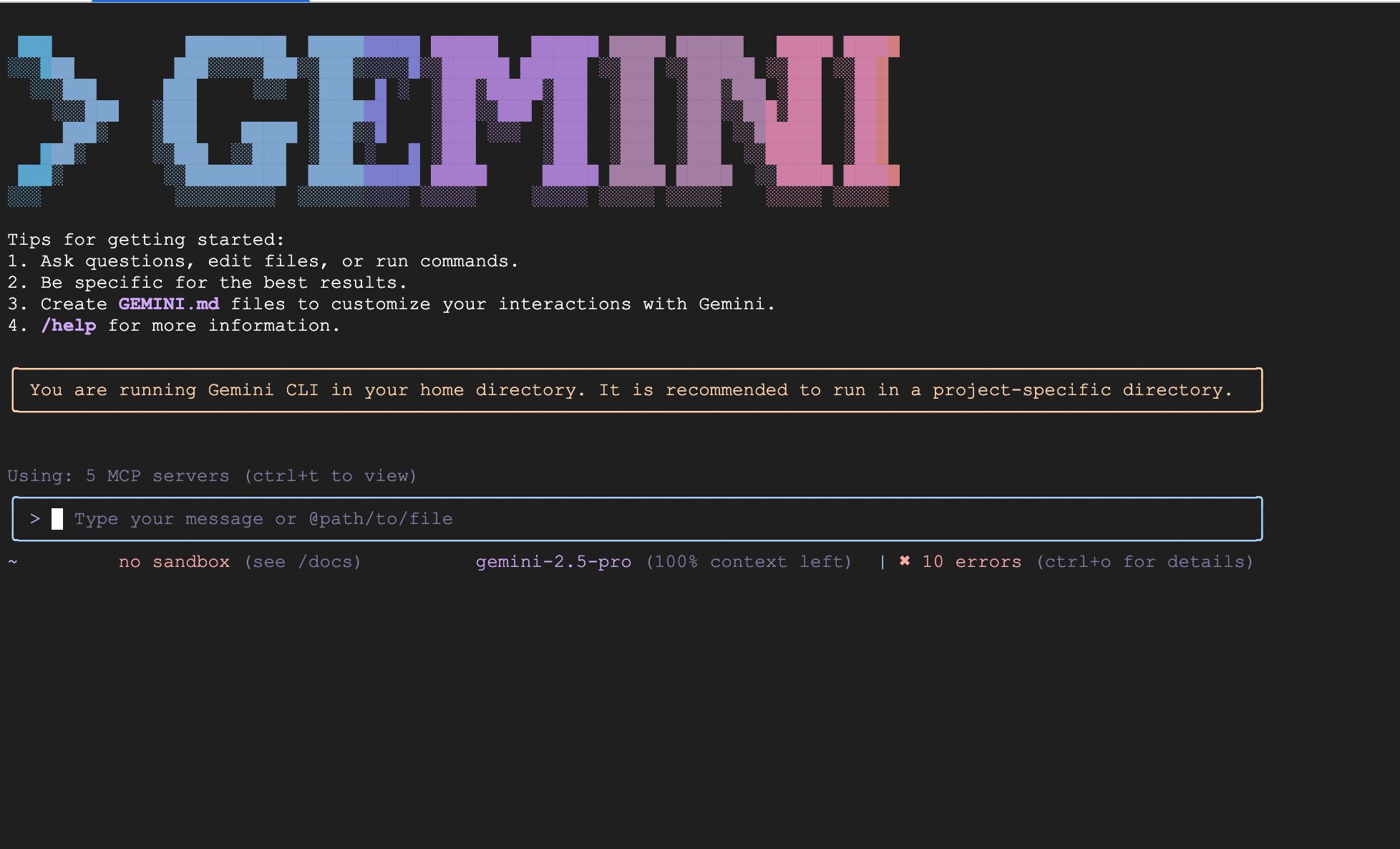
Neste laboratório prático, você vai instalar, autenticar a CLI do Gemini e testar alguns casos de uso básicos.
O que você vai aprender
- Entenda os conceitos básicos da CLI do Gemini.
- Aprenda a realizar tarefas básicas com a CLI do Gemini.
2. Antes de começar
- Se você ainda não tiver um projeto para usar, crie um no console do GCP.
- Neste laboratório, vamos usar o GCP Cloud Shell para realizar as etapas abaixo. Abra o Cloud Shell e defina o projeto usando o Cloud Shell.
- Abra o editor do Cloud Shell do GCP pressionando o botão do editor do Cloud Shell ou usando este link. Se o pop-up "Autorizar Shell" aparecer, clique para autorizar o editor do Cloud Shell.
- É possível verificar se o projeto já está autenticado usando o seguinte comando.
gcloud auth list
- Execute o comando a seguir no Cloud Shell para confirmar seu projeto.
gcloud config list project
- Se você não se lembrar do ID do projeto, liste todos os IDs com
gcloud projects list
- Se o projeto não estiver definido, use este comando:
gcloud config set project <YOUR_PROJECT_ID>
- Precisamos ativar alguns serviços para executar este laboratório. Execute o seguinte comando no Cloud Shell:
gcloud services enable aiplatform.googleapis.com
gcloud services enable cloudresourcemanager.googleapis.com
3. Instalação e autenticação
Instalação
A CLI do Gemini vem pré-instalada no editor do Cloud Shell do GCP . Se quiser usar, comece agora mesmo.
Você também pode instalar a CLI do Gemini no seu ambiente local.
Para instalar a CLI do Gemini no seu ambiente local, você precisa do Nodejs 20 ou mais recente. Execute o comando a seguir para instalar a CLI do Gemini.
npm install -g @google/gemini-cli
Para fazer upgrade para a versão mais recente , use o comando a seguir:
npm update -g @google/gemini-cli
Execute o Gemini com o comando a seguir no terminal.
gemini
Authentication
Se você estiver usando o GCP Cloud Shell Editor, já terá feito a autenticação se tiver aceitado autenticar o shell durante a execução.
Se você estiver executando localmente e ainda não tiver feito a autenticação, vai aparecer uma tela como a abaixo.
Você também pode digitar /auth para abrir a tela abaixo.
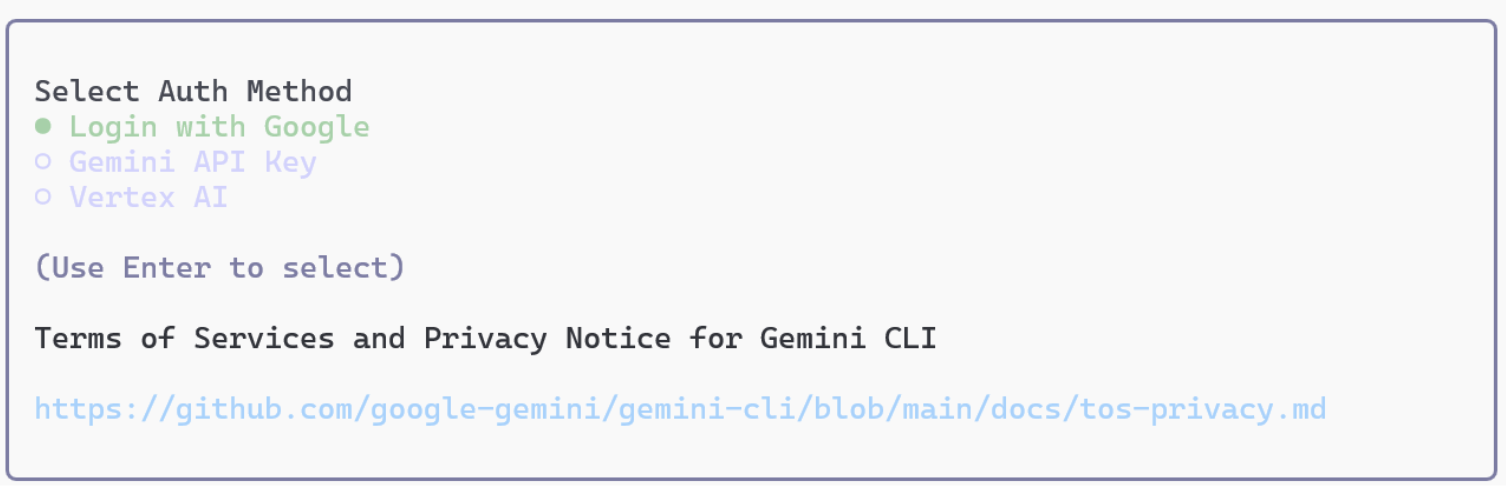
Figura 1: a CLI do Gemini oferece três métodos de autenticação.
Primeiro, saia da CLI do Gemini com o comando /quit.
Autenticar com o Google: executar /auth no console vai mostrar as opções de autenticação. Selecione "Fazer login com o Google" nas opções. A tela de autenticação do Google vai aparecer no navegador. Depois de fazer login, o console também será autenticado. Embora a autenticação esteja concluída, para usar a CLI Gemini, é necessário especificar um projeto do Google Cloud. Volte à tela do console e execute o comando a seguir para especificar o projeto. Também é possível especificar em um arquivo .env.
export GOOGLE_CLOUD_PROJECT=xxxxxxxxxxxxxxxxxxxxxxxxxxxxxxxxxxxxxxxxxxx
Autenticar com chave de API: para autenticar com uma chave de API, você precisa de uma. Você pode gerar uma chave de API em aistudio.google.com . Depois que a chave de API for emitida, defina-a no console da seguinte maneira:
export GEMINI_API_KEY=xxxxxxxxxxxxxxxxxxxxxxxxxxxxxxxxxxxxxxxxxxxx
Autenticar com a Vertex AI: para usar a API Gemini pela Vertex AI, siga estas etapas.
Primeiro, use o comando abaixo para fazer a autenticação no Google Cloud.
gcloud auth application-default login
Execute os seguintes comandos no terminal:
export GOOGLE_GENAI_USE_VERTEXAI=true
export GOOGLE_CLOUD_PROJECT=Your GCP Project Name
export GOOGLE_CLOUD_LOCATION=us-central1
4. Testar a CLI do Gemini
Agora você já pode testar a CLI do Gemini. Confira os casos de uso a seguir.
Primeiro, crie uma pasta de projeto, my_cli_project.
mkdir ~/my_cli_project
cd ~/my_cli_project
Executar o Gemini em uma pasta de projeto permite que você use a CLI do Gemini com segurança dentro dos limites dessa pasta.
- Se você ainda não estiver na CLI do Gemini, digite o seguinte no terminal do Cloud Shell para acessar a CLI do Gemini
gemini
- Executar um comando simples:
What is the weather today in Tokyo
今日の東京の天気について教えてください
Isso vai mostrar o clima em Tóquio. Executar isso automaticamente usa
Ferramenta GoogleSearch!
- Confirme as ferramentas instaladas: execute o seguinte comando no terminal da CLI do Gemini. Você vai encontrar a lista de ferramentas instaladas.
/tools
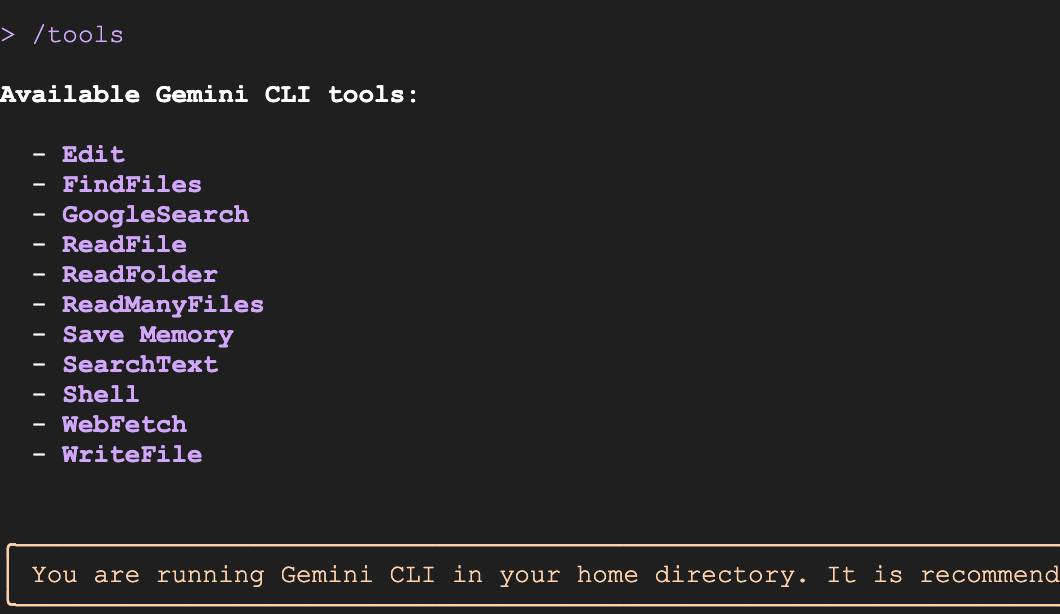
Figura 2: lista de ferramentas exibidas
- Receba notícias de um site de notícias local (por exemplo, https://mainichi.jp, mude para seu site de notícias local).
Get me the news summary from https://mainichi.jp/
このサイトからニュースのサマリーを教えてください https://mainichi.jp/
Você vai receber um resumo de notícias do site de notícias local. O agente usa automaticamente a ferramenta WebFetch para baixar o conteúdo do site de notícias e criar o resumo.
- Executar uma tarefa de várias etapas(mude para seu site local): me dê as notícias de https://mainichi.jp/, filtre apenas as notícias de esportes e faça um resumo para mim.
Get me the news from https://mainichi.jp/ and filter in only the sports news and summarize that for me.
https://mainichi.jp/ からニュースを取得し、スポーツニュースのみを抽出して、その要約を作成してください。
- Executar comandos do sistema : para executar comandos do sistema, pressione ! e digite os comandos. Para voltar ao modo normal, digite ! de novo.
Type ! and Enter key. This starts the command mode.
ls
pwd
Type ! to go back to normal mode.
- Crie um jogo da velha. Insira o seguinte comando (versão em inglês):
Please develop a Tic-Tac-Toe game that meets the following requirements. The solution should be split into separate HTML, CSS, and JavaScript files, with the JavaScript file handling the majority of the game logic independently.
1. General Requirements
The game format should be a match between one human player and one computer player.
When the game ends (a win/loss is determined, or a draw occurs), display "GAME OVER" on the screen along with the winner's name ("X wins!," "O wins!," or "Draw!").
Provide a "Reset" button to start a new game.
2. HTML (index.html)
Create the basic page structure.
The game board should consist of nine squares (cells). Each cell should be clickable and display the player's mark (X or O).
Provide an element to display the game status (e.g., current player's turn, game result).
Place the reset button for starting a new game.
Link the CSS and JavaScript files appropriately.
3. CSS (style.css)
Style the game board and cells so they are visually clear and easy to understand.
Add borders to the cells to indicate they are clickable areas.
Set appropriate font size and color for the X and O marks to ensure good visibility.
Style the game status display and the "GAME OVER" message to make them stand out.
Consider responsive design to ensure appropriate display on various screen sizes.
4. JavaScript (script.js)
It is strongly requested that the JavaScript file handle all the game logic.
4.1. Game State Management
Define an array or object to manage the game board state (e.g., ['', '', '', '', '', '', '', '', '']).
Define a variable to track the current player (X or O). The initial value should be X.
Define a boolean value to track whether the game has ended (win/loss or draw).
4.2. Game Initialization
Create a function to initialize the game board upon page load.
Clear all cells.
Set the current player to X.
Reset the game end flag.
Clear the game result display.
4.3. Player Interaction
Set up event listeners for cell clicks.
Only place the current player's mark and update the board state if the clicked cell is empty.
After placing the mark, execute the following:
Call the win/draw check function.
If a winner is not yet determined, switch the player (X to O, O to X).
4.4. Computer AI Logic
Create a function that is called when it is the computer's (O) turn.
Implement a simple logic where the computer randomly selects an empty cell to place its mark. (While difficulty can be increased in the future, random selection is sufficient initially.)
After the computer places its mark, perform the win/draw check, and if the game is not over, switch the turn back to the human player.
4.5. Win/Draw Determination
Create a function that determines the win/draw status based on the current board state.
Check the following winning conditions:
Three rows
Three columns
Two diagonals
If a player meets a winning condition, declare that player the winner.
If all cells are filled and no player meets a winning condition, declare a draw.
If a win or draw is determined, set the game end flag to true and display the "GAME OVER" message and the result.
4.6. Game End Handling
When the game ends (win/loss or draw), prevent further clicks on the cells.
Display the text "GAME OVER" followed by the message "X wins!," "O wins!," or "Draw!" underneath it.
4.7. Reset Functionality
When the "Reset" button is clicked, call the function to return the game to its initial state.
Insira o seguinte comando (versão em japonês):
以下の要件を満たす三目並べ(Tic-Tac-Toe)ゲームを開発してください。HTML、CSS、JavaScriptの各ファイルに分割し、JavaScriptはゲームロジックの大部分を単独で処理するようにしてください。
1. 全体要件
プレイヤーは人間1人、コンピューター1人の対戦形式とする。
ゲーム終了時(勝敗が決まった場合、または引き分けの場合)は、画面上に「GAME OVER」と表示し、勝者の名前(「Xの勝利!」「Oの勝利!」または「引き分け!」)も併記すること。
新しいゲームを開始するための「リセット」ボタンを設けること。
2. HTML (index.html)
基本的なページ構造を作成してください。
ゲームボードは、9つのマス目(セル)で構成されるようにしてください。各セルはクリック可能で、プレイヤーのマーク(XまたはO)が表示されるようにします。
ゲームの状態(現在のプレイヤーのターン、ゲーム結果など)を表示する要素を設けてください。
ゲームをリセットするためのボタンを配置してください。
CSSファイルとJavaScriptファイルを適切にリンクしてください。
3. CSS (style.css)
ゲームボードとマス目が視覚的に分かりやすいようにスタイルを設定してください。
マス目には枠線をつけ、クリック可能な領域であることがわかるようにする。
XとOの表示は、見やすいように適切なフォントサイズと色を設定する。
ゲームの状態表示、および「GAME OVER」メッセージが目立つようにスタイルを設定してください。
レスポンシブデザインを考慮し、様々な画面サイズで適切に表示されるようにしてください。
4. JavaScript (script.js)
JavaScriptファイルがゲームロジックの全てを処理することを強く要請します。
4.1. ゲームの状態管理
ゲームボードの状態を管理する配列またはオブジェクト(例: ['', '', '', '', '', '', '', '', ''])を定義してください。
現在のプレイヤー(XまたはO)を追跡する変数を定義してください。初期値はXとする。
ゲームが終了したかどうか(勝敗が決まったか、引き分けか)を追跡するブール値を定義してください。
4.2. ゲームの初期化
ページ読み込み時にゲームボードを初期化する関数を作成してください。
全てのマス目を空にする。
現在のプレイヤーをXに設定する。
ゲーム終了フラグをリセットする。
ゲーム結果表示をクリアする。
4.3. プレイヤーの操作
マス目をクリックした際のイベントリスナーを設定してください。
クリックされたマス目が空の場合のみ、現在のプレイヤーのマークを配置し、ボードの状態を更新する。
マークを配置した後、以下の処理を実行する。
勝敗判定関数を呼び出す。
勝敗が決まっていない場合、プレイヤーを交代する(XからO、OからXへ)。
4.4. コンピューターの思考ロジック
コンピューター(O)が手番の時に呼び出される関数を作成してください。
コンピューターは、空いているマス目の中からランダムに選択してマークを配置するシンプルなロジックを実装してください。(将来的に難易度を上げることも考慮できるが、最初はランダムで十分です)
コンピューターがマークを配置した後、勝敗判定を行い、勝敗が決まっていない場合はプレイヤーを人間に戻す。
4.5. 勝敗判定
現在のボードの状態に基づいて勝敗を判定する関数を作成してください。
以下の勝利条件をチェックする。
3つの行
3つの列
2つの対角線
勝利条件を満たすプレイヤーがいる場合、そのプレイヤーの勝利とする。
全てのマス目が埋まり、かつ勝利条件を満たすプレイヤーがいない場合、引き分けとする。
勝敗または引き分けが決まった場合、ゲーム終了フラグをtrueに設定し、「GAME OVER」メッセージと結果を表示する。
4.6. ゲーム終了時の処理
ゲームが終了した場合(勝敗が決まったか、引き分けか)は、それ以上マス目をクリックできないようにする。
「GAME OVER」というテキストと、その下に「Xの勝利!」「Oの勝利!」または「引き分け!」というメッセージを表示する。
4.7. リセット機能
「リセット」ボタンがクリックされた際に、ゲームを初期状態に戻す関数を呼び出す。
- Crie um terminal clicando em Terminal>Novo no terminal do editor do Cloud Shell. Defina o ID do projeto primeiro, se ainda não tiver feito isso.
gcloud projects list
gcloud config set project <YOUR_PROJECT_ID>
cd ~/my_cli_project
python3 -m http.server 8080
Isso vai iniciar um servidor Python. No navegador, abra (CTRL+clique se estiver no Cloud Shell):
http://localhost:8080
Isso vai iniciar um servidor Python. No navegador, abra (CTRL+clique se estiver no Cloud Shell):
5. Executar extensões da CLI do Gemini
A CLI do Gemini oferece algumas extensões muito úteis que podem ser instaladas e executadas com facilidade. Com elas, é possível se conectar a vários serviços e usá-los. https://geminicli.com/extensions/, uma lista de extensões disponíveis que cresce a cada dia. Para saber mais sobre as extensões da CLI do Gemini, consulte esta página: https://medium.com/google-cloud/gemini-cli-tutorial-series-part-11-gemini-cli-extensions-69a6f2abb659
Vamos instalar e executar uma extensão Gemini Nanobanana .
Para instalar a extensão, execute o seguinte comando.
gemini extensions install https://github.com/gemini-cli-extensions/nanobanana
Depois que a extensão for instalada, reinicie a CLI do Gemini e você poderá executar os seguintes comandos do nanobanana na CLI do Gemini.
/generate: geração de uma ou várias imagens com opções de estilo/variação/edit: edição de imagens/restore: restauração de imagens/icon: gere ícones de apps, favicons e elementos de interface em vários tamanhos/pattern: gere padrões e texturas perfeitos para planos de fundo/story- Gerar imagens sequenciais que contam uma história ou um processo visual/diagram: gere diagramas técnicos, fluxogramas e simulações de arquitetura./nanobanana: interface de linguagem natural
Vamos executar alguns comandos
Antes de executar o Nanobanana, acesse aistudio.google.com e defina uma chave da API Gemini aqui.
export NANOBANANA_GEMINI_API_KEY=YOUR_API_KEY
Versão em inglês
# Single image
/generate "a watercolor painting of a fox in a snowy forest"

# Multiple variations with preview
/generate "sunset over mountains" --count=3 --preview

# Style variations
/generate "mountain landscape" --styles="watercolor,oil-painting" --count=4

# Specific variations with auto-preview
/generate "coffee shop interior" --variations="lighting,mood" --preview
Versão em japonês
# Single image
/generate "雪の森のキツネの水彩画"

# Multiple variations with preview
/generate "山にかかる夕焼け" --count=3 --preview

# Style variations
/generate "山岳風景" --styles="watercolor,oil-painting" --count=4

# Specific variations with auto-preview
/generate "コーヒーショップのインテリア" --variations="lighting,mood" --preview
Editar imagens
Mude o nome do arquivo para o nome do arquivo local.
/edit my_photo.png "change the color of fox to blue"
6. Desafio!
Pense no comando para fazer esses aplicativos!
-Your favorite game
-A photo gallery application
-A Manga generator App
-お気に入りのゲーム
-フォトギャラリーアプリケーション
-マンガ生成アプリ
7. Concluído
E pronto! Muito bem! Para saber mais, confira os seguintes recursos.