

1. 简介
本 Codelab 将引导您使用 Python 构建自定义 MCP(模型上下文协议)服务器,将其部署到 Google Cloud Run,并将其与 Gemini CLI 连接,以使用自然语言执行真实的 Google Cloud Storage 操作。
架构流程:Gemini CLI → Cloud Run → MCP
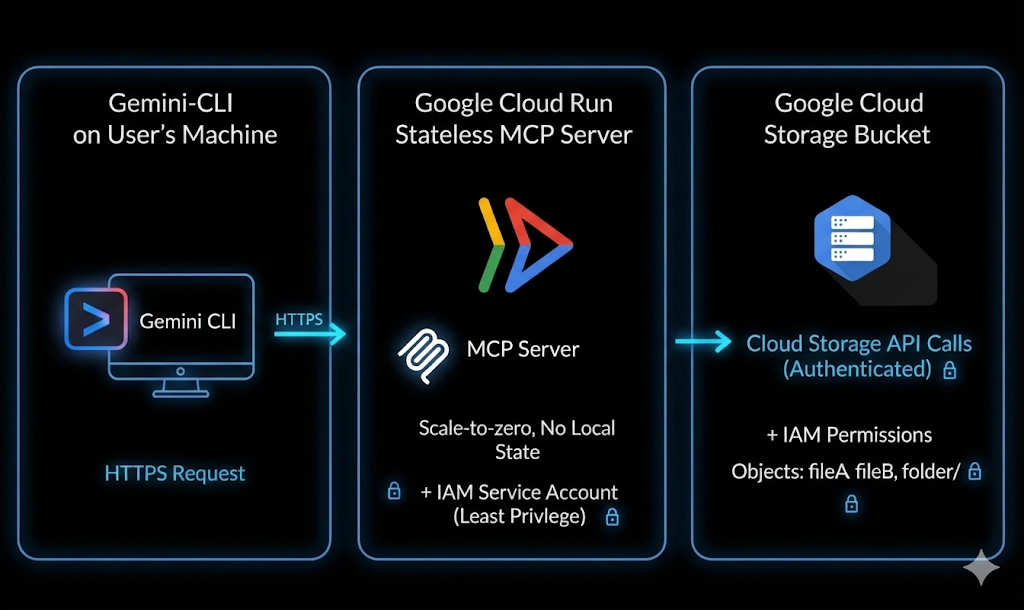
想象一下:您打开终端,在 AI 智能体中输入一个简单的提示,例如以下提示:
List my GCS bucketsCreate a GCS bucket named <bucket-name>Tell me about the metadata of my GCS object
几秒钟内,云端会听取并执行指令。无需复杂的命令。无需在标签页之间来回切换。只需使用简单的语言,即可将自然语言转换为实际的云操作。
实践内容
您将构建并部署一个自定义 MCP 服务器,用于将 Gemini CLI 与 Google Cloud Storage 相连接。
您将学习以下内容:
- 构建基于 Python 的 MCP 服务器
- 将应用容器化
- 将其部署到 Cloud Run
- 使用 IAM 和身份令牌保护它
- 将其与 Gemini CLI 相关联
- 使用自然语言执行实时 GCS 操作
学习内容
- 什么是 MCP(Model Context Protocol),以及它的运作方式
- 如何使用 Python 构建工具调用功能
- 如何将容器化应用部署到 Cloud Run
- Gemini CLI 如何与外部 MCP 服务器集成
- 如何安全地对 Cloud Run 服务进行身份验证
- 如何使用 AI 执行真实的 Google Cloud Storage 操作
所需条件
- Chrome 网络浏览器
- Gmail 账号
- 启用了结算功能的 Google Cloud 项目
- Gemini CLI(预安装在 Google Cloud Shell 中)
- 基本熟悉 Python 和 Google Cloud
本 Codelab 假定用户熟悉 Python 的基本知识
2. 准备工作
创建项目
- 在 Google Cloud Console 的项目选择器页面上,选择或创建一个 Google Cloud 项目。
- 确保您的 Cloud 项目已启用结算功能。了解如何检查项目是否已启用结算功能。
- 您将使用 Cloud Shell,这是一个在 Google Cloud 中运行的命令行环境,它预加载了 bq。点击 Google Cloud 控制台顶部的“激活 Cloud Shell”。

- 连接到 Cloud Shell 后,您可以使用以下命令检查自己是否已通过身份验证,以及项目是否已设置为您的项目 ID:
gcloud auth list
- 在 Cloud Shell 中运行以下命令,以确认 gcloud 命令了解您的项目。
gcloud config list project
- 如果项目未设置,请使用以下命令进行设置:
gcloud config set project <YOUR_PROJECT_ID>
- 通过以下命令启用所需的 API。这可能需要几分钟的时间,请耐心等待。
gcloud services enable \
  run.googleapis.com \
  artifactregistry.googleapis.com \
  cloudbuild.googleapis.com
如果系统提示您进行授权,请点击“授权”继续。
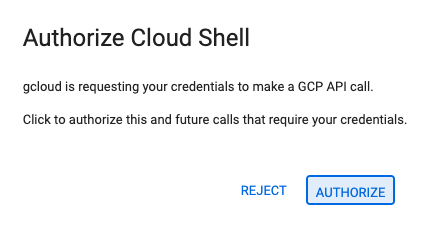
成功执行该命令后,您应该会看到类似如下所示的消息:
Operation "operations/..." finished successfully.
如果遗漏了任何 API,您始终可以在实施过程中启用它。
如需了解 gcloud 命令和用法,请参阅文档。
准备 Python 项目
在本部分中,您将创建用于托管 MCP 服务器的 Python 项目,并配置其依赖项以部署到 Cloud Run。
创建项目目录
首先,创建一个名为 mcp-on-cloudrun 的新文件夹来存储源代码:
mkdir gcs-mcp-server && cd gcs-mcp-server
创建 requirements.txt
touch requirements.txt
cloudshell edit ~/gcs-mcp-server/requirements.txt
将以下内容添加到该文件中:
fastmcp
google-cloud-storage
google-api-core
pydantic
保存文件。
3. 创建 MCP 服务器
在本部分中,您将创建 MCP 服务器,该服务器会将 Google Cloud Storage 操作公开为可调用的工具。
此服务器将:
- 注册 MCP 工具
- 连接到 Google Cloud Storage
- 通过 HTTP 运行
- 可部署到 Cloud Run
现在,我们来创建 main.py 内的核心 MCP 逻辑。
以下是完整代码,其中定义了用于管理 Google Cloud Storage 的多种工具,包括列出和创建存储分区,以及上传、下载和管理 Blob
创建主应用文件
在 mcp-on-cloudrun 目录中,创建一个名为 main.py 的新文件:
touch main.py
使用 Cloud Shell 编辑器打开文件:
cloudshell edit ~/gcs-mcp-server/main.py
将以下来源添加到 main.py 文件内容中:
import asyncio
import logging
import os
from datetime import timedelta
from typing import List, Dict, Any
from fastmcp import FastMCP
from google.cloud import storage
from google.api_core import exceptions

# ---------------------------------------------------------
# 🌐 Initialize MCP
# ---------------------------------------------------------
logging.basicConfig(format="[%(levelname)s]: %(message)s", level=logging.INFO)
logger = logging.getLogger(__name__)

mcp = FastMCP(name="MyEnhancedGCSMCPServer")
# ---------------------------------------------------------
# 1️⃣ Simple Greeting
# ---------------------------------------------------------
@mcp.tool
def sayhi(name: str) -> str:
  """Returns a friendly greetings"""
  return f"Hello {name}! It's a pleasure to connect from your enhanced MCP Server."

# ---------------------------------------------------------
# 2️⃣ List all GCS buckets
# ---------------------------------------------------------
@mcp.tool
def list_gcs_buckets() -> List[str]:
  """Lists all GCS buckets in the project."""
  try:
      storage_client = storage.Client()
      buckets = storage_client.list_buckets()
      return [bucket.name for bucket in buckets]
  except exceptions.Forbidden as e:
      return [f"Error: Permission denied to list buckets. Details: {e}"]
  except Exception as e:
      return [f"An unexpected error occurred: {e}"]

# ---------------------------------------------------------
# 3️⃣ Create a new bucket
# ---------------------------------------------------------
@mcp.tool
def create_bucket(bucket_name: str, location: str = "US") -> str:
  """Creates a new GCS bucket. Bucket names must be globally unique."""
  try:
      storage_client = storage.Client()
      bucket = storage_client.bucket(bucket_name)
      bucket.location = location
      storage_client.create_bucket(bucket)
      return f"✅ Bucket '{bucket_name}' created successfully in '{location}'."
  except exceptions.Conflict:
      return f"⚠️ Error: Bucket '{bucket_name}' already exists."
  except exceptions.Forbidden as e:
      return f"❌ Error: Permission denied to create bucket. Details: {e}"
  except Exception as e:
      return f"❌ Unexpected error: {e}"

# ---------------------------------------------------------
# 4️⃣ Delete a bucket
# ---------------------------------------------------------
@mcp.tool
def delete_bucket(bucket_name: str) -> str:
  """Deletes a GCS bucket."""
  try:
      storage_client = storage.Client()
      bucket = storage_client.bucket(bucket_name)
      bucket.delete(force=True)
      return f"🗑️ Bucket '{bucket_name}' deleted successfully."
  except exceptions.NotFound:
      return f"⚠️ Error: Bucket '{bucket_name}' not found."
  except exceptions.Forbidden as e:
      return f"❌ Error: Permission denied to delete bucket. Details: {e}"
  except Exception as e:
      return f"❌ Unexpected error: {e}"

# ---------------------------------------------------------
# 5️⃣ List objects in a bucket
# ---------------------------------------------------------
@mcp.tool
def list_objects(bucket_name: str) -> List[str]:
  """Lists all objects in a specified GCS bucket."""
  try:
      storage_client = storage.Client()
      blobs = storage_client.list_blobs(bucket_name)
      return [blob.name for blob in blobs]
  except exceptions.NotFound:
      return [f"⚠️ Error: Bucket '{bucket_name}' not found."]
  except Exception as e:
      return [f"❌ Unexpected error: {e}"]
# ---------------------------------------------------------
# Delete file from a bucket
# ---------------------------------------------------------
@mcp.tool
def delete_blob(bucket_name: str, blob_name: str) -> str:
  """Deletes a blob from a GCS bucket."""
  try:
      storage_client = storage.Client()
      bucket = storage_client.bucket(bucket_name)
      blob = bucket.blob(blob_name)
      blob.delete()
      return f"🗑️ Blob '{blob_name}' deleted from bucket '{bucket_name}'."
  except exceptions.NotFound:
      return f"⚠️ Error: Bucket '{bucket_name}' or blob '{blob_name}' not found."
  except exceptions.Forbidden as e:
      return f" Permission denied. Details: {e}"
  except Exception as e:
      return f" Unexpected error: {e}"

# ---------------------------------------------------------
# Get bucket metadata
# ---------------------------------------------------------
@mcp.tool
def get_bucket_metadata(bucket_name: str) -> Dict[str, Any]:
  """Retrieves metadata for a GCS bucket."""
  try:
      storage_client = storage.Client()
      bucket = storage_client.get_bucket(bucket_name)
      return {
          "id": bucket.id,
          "name": bucket.name,
          "location": bucket.location,
          "storage_class": bucket.storage_class,
          "created": bucket.time_created.isoformat() if bucket.time_created else None,
          "updated": bucket.updated.isoformat() if bucket.updated else None,
          "versioning_enabled": bucket.versioning_enabled,
      }
  except exceptions.NotFound:
      return {"error": f" Bucket '{bucket_name}' not found."}
  except Exception as e:
      return {"error": f" Unexpected error: {e}"}

# ---------------------------------------------------------
# Get object metadata
# ---------------------------------------------------------
@mcp.tool
def get_blob_metadata(bucket_name: str, blob_name: str) -> Dict[str, Any]:
  """Retrieves metadata for a specific blob."""
  try:
      storage_client = storage.Client()
      bucket = storage_client.bucket(bucket_name)
      blob = bucket.get_blob(blob_name)
      if not blob:
          return {"error": f" Blob '{blob_name}' not found in '{bucket_name}'."}
      return {
          "name": blob.name,
          "bucket": blob.bucket.name,
          "size": blob.size,
          "content_type": blob.content_type,
          "updated": blob.updated.isoformat() if blob.updated else None,
          "storage_class": blob.storage_class,
          "crc32c": blob.crc32c,
          "md5_hash": blob.md5_hash,
      }
  except exceptions.NotFound:
      return {"error": f" Bucket '{bucket_name}' not found."}
  except Exception as e:
      return {"error": f" Unexpected error: {e}"}

# ---------------------------------------------------------
# 🚀 Entry Point
# ---------------------------------------------------------
if __name__ == "__main__":
  port = int(os.getenv("PORT", 8080))
  logger.info(f"🚀 Starting Enhanced GCS MCP Server on port {port}")
  asyncio.run(
      mcp.run_async(
          transport="http",
          host="0.0.0.0",
          port=port,
      )
  )
添加代码后,保存文件。
您的项目结构现在应如下所示:
gcs-mcp-server/
├── requirements.txt
└── main.py
让我们简要了解一下代码:
导入和设置:
代码首先会导入必要的库。
- 标准库:
asyncio用于异步执行,logging用于输出状态消息,os用于环境变量。 - FastMCP:用于创建 Model Context Protocol 服务器的核心框架。
- Google Cloud Storage:导入
google.cloud.storage库以与 GCS 交互,并导入exceptions以进行错误处理。
初始化:
我们配置了日志记录格式,以帮助调试和跟踪服务器的身份。此外,我们还配置了一个名为 MyEnhancedGCSMCPServer 的 FastMCP 实例。此对象 (mcp) 将用于注册服务器公开的所有工具(函数)。我们定义了以下工具:
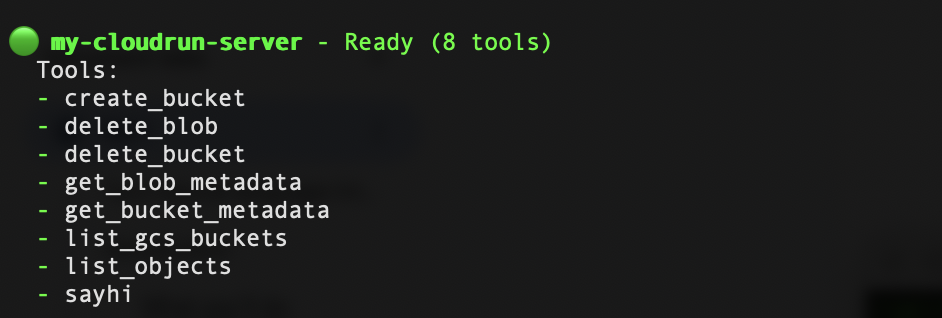
list_gcs_buckets:检索关联的 Google Cloud 项目中的所有存储分区的列表。create_bucket:创建具有特定名称和位置的新存储分区。delete_bucket:删除现有存储分区。list_objects:列出特定存储分区中的所有文件 (blob)。delete_blob:从存储分区中删除单个特定文件。get_bucket_metadata:返回有关存储分区的技术详细信息(位置、存储类别、版本控制状态、创建时间)。get_blob_metadata:返回有关特定文件的技术详细信息(大小、内容类型、MD5 哈希、上次更新时间)。
入口点:
此属性用于配置端口,如果未设置,则默认为 8080。然后,它使用 asyncio.run() 通过 mcp.run_async 异步启动服务器。最后,它将服务器配置为通过 HTTP (host 0.0.0.0) 运行,从而使其可供传入的网络请求访问。
4. 将 MCP 服务器容器化
在本部分中,您将创建一个 Dockerfile,以便将 MCP 服务器部署到 Cloud Run。
Cloud Run 需要容器化应用。您将定义如何构建和启动应用。
创建 Dockerfile
创建名为 Dockerfile 的新文件:
touch Dockerfile
在 Cloud Shell Editor 中打开该文件:
cloudshell edit ~/gcs-mcp-server/Dockerfile
添加 Docker 配置
将以下内容粘贴到 Dockerfile 中:
FROM python:3.11-slim
ENV PYTHONDONTWRITEBYTECODE=1
ENV PYTHONUNBUFFERED=1
WORKDIR /app
RUN apt-get update && apt-get install -y \
   build-essential \
   gcc \
   && rm -rf /var/lib/apt/lists/*
RUN pip install --upgrade pip
COPY . .
RUN pip install -r requirements.txt
ENV PORT=8080
EXPOSE 8080
CMD ["python", "main.py"]
添加内容后,保存文件。您的项目结构现在应如下所示:
gcs-mcp-server/
├── requirements.txt
├── main.py
└── Dockerfile
5. 部署到 Cloud Run
现在,直接从源代码部署 MCP 服务器。
在 Cloud Shell 中运行以下命令:
gcloud run deploy gcs-mcp-server \
   --no-allow-unauthenticated \
   --region=us-central1 \
   --source=. \
   --labels=session=buildersdayblr
当系统提示
- 允许未经身份验证的调用?→ 否
Cloud Build 将:
- 构建容器映像
- 将其推送到 Artifact Registry
- 将其部署到 Cloud Run
输入 Y,确认可以创建 Artifact Registry 代码库。
Deploying from source requires an Artifact Registry Docker repository to store built containers. A repository named [cloud-run-source-deploy] in region [us-central1] will be created.

Do you want to continue (Y/n)?  Y
成功部署后,您会看到一条成功消息,其中包含 Cloud Run 服务网址。
您还可以通过 Google Cloud 控制台中的 Cloud Run → Services来验证部署。

6. Gemini CLI 配置
到目前为止,我们已在 Cloud Run 上构建并部署了 MCP 服务器。
现在到了有趣的部分 - 将其与 Gemini CLI 连接,并将自然语言提示转换为实际的云操作。
授予 Cloud Run Invoker 权限
由于我们的 Cloud Run 服务是私有的,因此我们将使用身份令牌进行身份验证,并分配正确的 IAM 权限。
我们使用 --no-allow-unauthenticated 部署了该服务,因此您必须授予调用该服务的权限。
设置项目 ID:
export GOOGLE_CLOUD_PROJECT=$(gcloud config get-value project)
为您自己授予 Cloud Run Invoker 角色:
gcloud projects add-iam-policy-binding $GOOGLE_CLOUD_PROJECT \
  --member=user:$(gcloud config get-value account) \
  --role='roles/run.invoker'
这样,您的账号就可以安全地调用 Cloud Run 服务。
生成身份令牌
Cloud Run 需要身份令牌才能进行身份验证访问。
生成一个:
export PROJECT_NUMBER=$(gcloud projects describe $GOOGLE_CLOUD_PROJECT --format="value(projectNumber)")
export ID_TOKEN=$(gcloud auth print-identity-token)
验证:
echo $PROJECT_NUMBER
echo $ID_TOKEN
您将在 Gemini CLI 配置中使用此令牌。
在 Gemini CLI 中配置 MCP 服务器
打开 Gemini CLI 设置文件:
cloudshell edit ~/.gemini/settings.json
添加以下配置:
{
 "ide": {
   "enabled": true,
   "hasSeenNudge": true
 },
 "mcpServers": {
   "my-cloudrun-server": {
     "httpUrl": "https://gcs-mcp-server-$PROJECT_NUMBER.asia-south1.run.app/mcp",
     "headers": {
       "Authorization": "Bearer $ID_TOKEN"
     }
   }
 },
 "security": {
   "auth": {
     "selectedType": "cloud-shell"
   }
 }
}
验证 Gemini CLI 中配置的 MCP 服务器
通过以下命令在 Cloud Shell 终端中启动 Gemini CLI:
gemini
您将看到以下输出内容
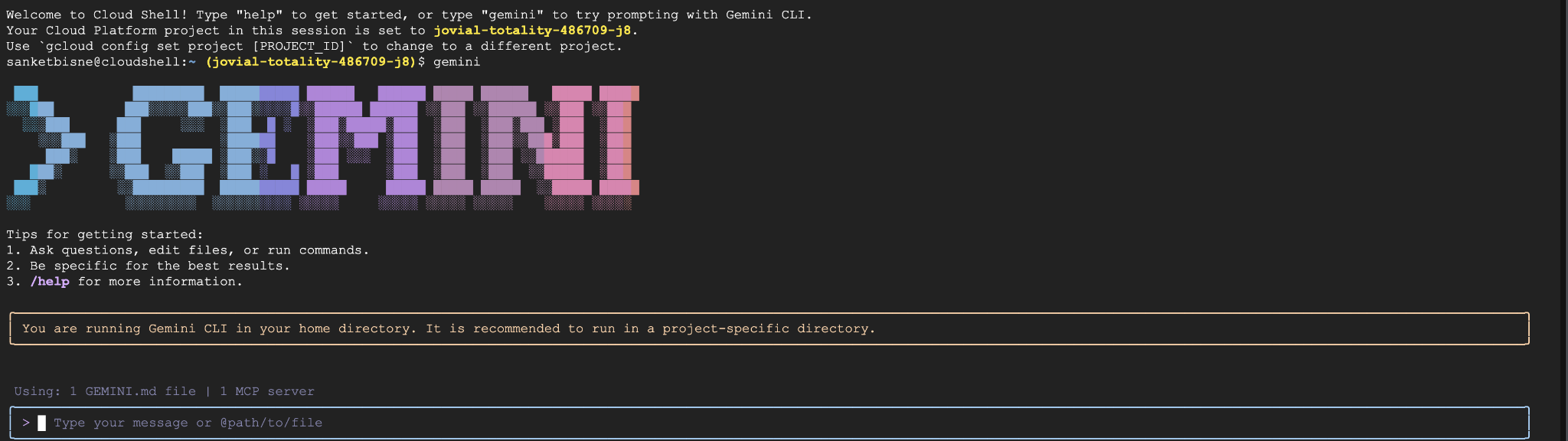
在 Gemini CLI 中,运行以下命令:
/mcp refresh
/mcp list
现在,您应该会看到您的 gcs-cloudrun-serve 已注册。示例屏幕截图如下所示:
7. 通过自然语言调用 Google 存储空间操作
创建存储桶
Create a bucket named my-ai-bucket in asia-south1 region
系统会提示您,请求您授予从 MCP 服务器调用 create_bucket 工具的权限。
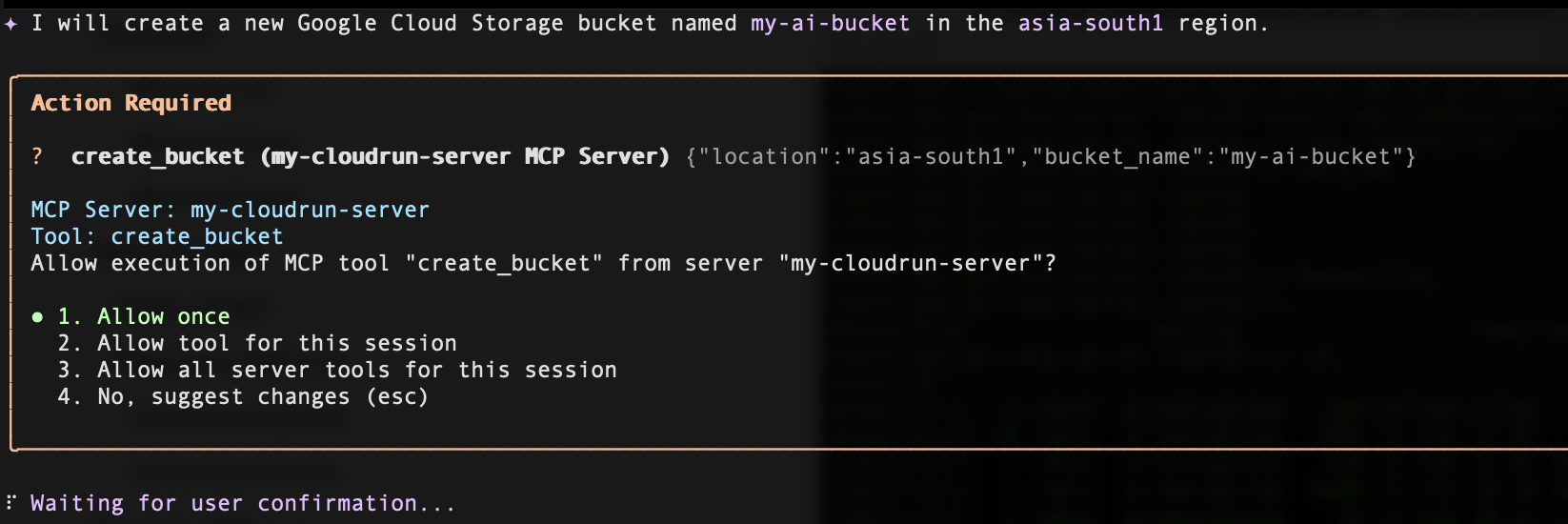
点击“允许一次”,然后系统会在您请求的特定区域中成功创建存储分区。
列出存储桶
如需列出存储分区,请输入以下提示:
List all my GCS buckets
删除存储分区
如需删除存储分区,请输入以下提示(将 <your_bucket_name> 替换为您的存储分区名称):
Delete the bucket <your_bucket_name>
获取存储分区的元数据
如需获取存储分区的元数据,请输入以下提示(将 <your_bucket_name> 替换为您的存储分区名称):
Give me metadata of the <your_bucket_name>
8. 清理
在决定删除 Google Cloud 项目之前,请先阅读本部分的所有内容,因为此操作通常不可逆。
为避免系统因本 Codelab 中使用的资源向您的 Google Cloud 账号收取费用,请按照以下步骤操作:
- 在 Google Cloud 控制台中,前往“管理资源”页面。
- 在项目列表中,选择要删除的项目。
- 点击删除。
在对话框中输入项目 ID,然后点击“关停”以永久删除项目。
删除项目后,系统会停止对该项目中使用的所有资源计费,包括 Cloud Run 服务和存储在 Artifact Registry 中的容器映像。
或者,如果您想保留项目但移除已部署的服务,请执行以下操作:
- 在 Google Cloud 控制台中,前往 Cloud Run。
- 选择 gcs-mcp-server 服务。
- 点击“删除”以移除相应服务。
或者在 Cloud Shell 终端中运行以下 gcloud 命令。
gcloud run services delete gcs-mcp-server --region=us-central1
9. 总结
🎉 恭喜!您刚刚构建了第一个 AI 赋能的云工作流!
您已实现:
- 基于 Python 的自定义 MCP 服务器
- Google Cloud Storage 的工具调用功能
- 使用 Docker 进行容器化
- 安全地部署到 Cloud Run
- 基于身份的身份验证
- 与 Gemini CLI 集成
现在,您可以扩展此架构,以支持其他 Google Cloud 服务,例如 BigQuery、Pub/Sub 或 Compute Engine。
此模式演示了 AI 系统如何通过结构化工具调用与云基础架构安全地交互。